

iOS 6 把畫面旋轉的控制邏輯從 `shouldAutorotateToInterfaceOrientation:` 換成 `supportedInterfaceOrientations` 加 `shouldAutorotate`。單一畫面的 App 改起來不難,但只要專案裡有 TabBarController 或 NavigationController,旋轉方向就不再是「一個 ViewController 決定」這麼單純,而是得一路往下問到目前顯示的子畫面。
單一畫面怎麼設定支援的旋轉方向?
在 ViewController 裡覆寫 `supportedInterfaceOrientations` 回傳想支援的方向遮罩,再讓 `shouldAutorotate` 回傳 `YES`,這個畫面就能依裝置方向旋轉。
```objective-c
//支援Xcode 4.5
- (NSUInteger) supportedInterfaceOrientations {
//僅正面
// return UIInterfaceOrientationMaskPortrait;
//支援縱向(利用 | 設定多參數)
// return UIInterfaceOrientationMaskPortrait
// | UIInterfaceOrientationMaskPortraitUpsideDown;
//支援橫向
//UIInterfaceOrientationMaskLandscape:支援按鈕在左、按鈕在右
// return UIInterfaceOrientationMaskLandscape;
//支援四個方向
return UIInterfaceOrientationMaskAll;
}
- (BOOL) shouldAutorotate {
return YES;
}
```
`UIInterfaceOrientationMaskAll`、`UIInterfaceOrientationMaskPortrait`、`UIInterfaceOrientationMaskLandscape` 這類遮罩值可以用 `|` 疊加,所以「支援直向兩種、不支援橫向」這種組合也寫得出來,不必為每種方向各寫一個判斷式。
用了 TabBarController 之後,旋轉方向要怎麼一路往下傳?
一旦畫面架構是 TabBarController 加 NavigationController,最上層的 AppDelegate 並不知道使用者現在停在哪一個分頁、哪一層畫面,所以旋轉方向必須從 AppDelegate 開始,一路詢問到目前真正顯示的那個 ViewController。
設定步驟如下:
- 在 Xcode 專案設定裡勾選要支援的裝置方向(Deployment Info → Device Orientation)。
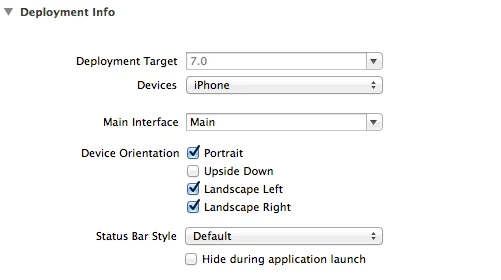
- 在 AppDelegate 加上這段,把詢問對象指向 rootViewController 目前顯示的畫面:
```objective-c
- (NSUInteger)application:(UIApplication )application supportedInterfaceOrientationsForWindow:(UIWindow )window
{
NSUInteger orientations = UIInterfaceOrientationMaskAll;
if (self.window.rootViewController) {
UIViewController presented = [[(UINavigationController )self.window.rootViewController viewControllers] lastObject];
orientations = [presented supportedInterfaceOrientations];
}
return orientations;
}
```
- 在 TabBarController 裡把三個方法都轉發給目前選取的分頁(`selectedViewController`):
```objective-c
-(BOOL)shouldAutorotateToInterfaceOrientation:(UIInterfaceOrientation)interfaceOrientation {
return [self.selectedViewController shouldAutorotateToInterfaceOrientation:interfaceOrientation];
}
-(NSUInteger)supportedInterfaceOrientations {
if (self.selectedViewController)
return [self.selectedViewController supportedInterfaceOrientations];
return UIInterfaceOrientationMaskPortrait;
}
-(BOOL)shouldAutorotate {
return [self.selectedViewController shouldAutorotate];
}
```
- 對於不支援旋轉的子畫面,固定回傳直向:
```objective-c
- (BOOL)shouldAutorotateToInterfaceOrientation:(UIInterfaceOrientation)interfaceOrientation
{
return (interfaceOrientation == UIInterfaceOrientationPortrait);
}
- (BOOL)shouldAutorotate
{
return NO;
}
- (NSUInteger)supportedInterfaceOrientations
{
return UIInterfaceOrientationMaskPortrait;
}
```
- 對於要支援旋轉的子畫面,開放到「除了上下顛倒以外的所有方向」:
```objective-c
- (BOOL)shouldAutorotateToInterfaceOrientation:(UIInterfaceOrientation)interfaceOrientation
{
return YES;
}
- (BOOL)shouldAutorotate
{
return YES;
}
- (NSInteger)supportedInterfaceOrientations
{
return UIInterfaceOrientationMaskAllButUpsideDown;
}
```
這一整條轉發鏈的關鍵在於:每一層容器(AppDelegate、TabBarController)都不自己決定方向,只負責把問題往下傳給真正顯示中的畫面去回答。哪個畫面該轉、哪個不該轉,最終都是最底層那個 ViewController 說了算。
NavigationController 底下的單一畫面要怎麼設定?
如果旋轉方向的差異只發生在 NavigationController 底下的某幾個畫面(沒有 TabBarController),做法類似,但轉發對象換成 `visibleViewController`:
```objective-c
- (BOOL)shouldAutorotateToInterfaceOrientation:(UIInterfaceOrientation)interfaceOrientation
{
return [self.visibleViewController shouldAutorotateToInterfaceOrientation:interfaceOrientation];
}
- (BOOL)shouldAutorotate {
return [self.visibleViewController shouldAutorotate];
}
- (NSUInteger)supportedInterfaceOrientations {
return [self.visibleViewController supportedInterfaceOrientations];
}
```
`visibleViewController` 會回傳目前實際顯示在畫面上的那個 ViewController(也就是 push 到最上層、使用者看得到的那一個),所以旋轉判斷永遠對應到使用者當下所在的畫面,而不是整個 navigation stack。
常見問題
為什麼設定了 `supportedInterfaceOrientations` 卻沒有效果?
多半是因為 App 架構裡有 TabBarController 或 NavigationController,而容器本身沒有把方法轉發給目前顯示的子畫面。方向設定要一路傳到 AppDelegate、容器、再到子畫面,缺一層就會被容器的預設值蓋掉。
`shouldAutorotate` 和 `supportedInterfaceOrientations` 各自負責什麼?
`shouldAutorotate` 決定這個畫面「要不要」自動旋轉,`supportedInterfaceOrientations` 決定「可以轉到哪些方向」。兩者要同時回傳正確的值,畫面才會依裝置方向轉動。
只想讓部分畫面支援橫向,其他畫面固定直向,可以嗎?
可以。做法是讓容器(TabBarController/NavigationController)統一把方法轉發給目前顯示的子畫面,再由各子畫面各自回傳自己支援的方向遮罩,如上面的範例所示。
參考資料
Apple Developer Documentation,`supportedInterfaceOrientations` 屬性說明,存取日期:2026-08-27。https://developer.apple.com/documentation/uikit/uiviewcontroller/1621435-supportedinterfaceorientations
最後更新
本文最後更新於 2026-08-27。原文發布於 2013-12-11,內容為 iOS 6/7 時期 Objective-C 專案的旋轉方向設定筆記,保留原始程式碼與設定步驟。
延伸閱讀
關於作者 {#author}
Claire Chang | 企業 AI 導入與流程轉型顧問。專注於 AI Agent 架構設計、ERP 系統整合與企業 AI 治理。
首次發布:2013-12-11