

連連看只要點選兩個圖案,就會判斷能不能消除。消除的條件只有兩個:兩個圖案相同,而且連線不超過兩個轉彎。這篇接續前一篇文章的邏輯發想,把判斷流程實際寫成 Angular + TypeScript 的程式碼:先處理遊戲主流程,再依序實作「判斷圖案相同」與「連線邏輯」兩個部分。
連連看的主遊戲流程怎麼設計?
主流程是:玩家先點第一個圖案(代表想消除它),再點第二個圖案,這時判斷兩個圖案是否符合可消除條件,可以消除就把兩個點從盤面上清掉。
流程如下:
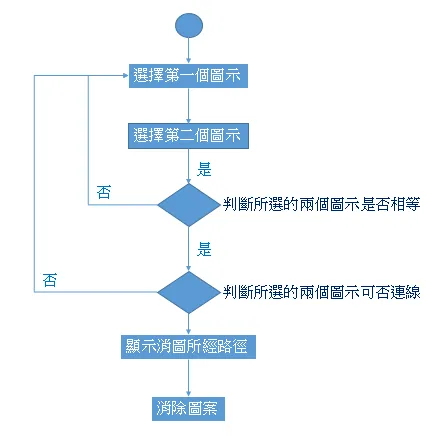
對應的 Angular controller 程式碼:
```js
var app = angular.module('LianLianKan', []);
app.controller('myCtrl', function ($scope) {
$scope.select1 = new Point(-1, -1);
$scope.select2 = new Point(-1, -1);
$scope.selected = false;
let msgArra = [];
$scope.message = msgArra;
let board = new Board();
$scope.boardContent = board.board;
$scope.click = function (x: number, y: number) {
if ($scope.selected) {
$scope.select2 = new Point(x, y);
if (board.hasSameValue($scope.select1, $scope.select2)) {
if (! ($scope.select1.x == x && $scope.select1.y == y) ) {//確認所選的兩個點不一樣
let path = new Path($scope.select1, $scope.select2, board);
if(path.canLinkInLine()){
board.clearPoint($scope.select1);
board.clearPoint($scope.select2);
msgArra.push(path);
}
}
}
$scope.selected = false;
} else {
$scope.select1 = new Point(x, y);
$scope.selected = true;
}
};
});
```
怎麼判斷兩個圖案是否相同?
在 `Board` 類別加上 `hasSameValue`,直接比較盤面上兩個座標的值:
```js
public hasSameValue(point1: Point, point2: Point): boolean {
return this.board[point1.x][point1.y] == this.board[point2.x][point2.y];
}
```
圖案相同只是第一道關卡,接著才是最核心的連線判斷。
連線邏輯(Path 類別)怎麼寫?
新建一個 `Path` 類別,`canLinkInLine()` 依序嘗試六種連線方式:從上面消、從下面消、從左邊消、從右邊消、左右連消、上下連消。只要其中一種成立,就把路徑存到 `path_Detail` 並回傳 true。
```js
class Path {
public point1: Point;
public point2: Point;
readonly board: Board;
public path_Detail: Array<Point>;
constructor(point1: Point, point2: Point, board: Board) {
this.point1 = point1;
this.point2 = point2;
this.board = board;
}
public canLinkInLine(): boolean {
//從上面消:兩個點都往上找最遠能到達的距離
let point1UP = this.board.getNearByPointByDirection(this.point1, Direction.UP);
let point2UP = this.board.getNearByPointByDirection(this.point2, Direction.UP);
{
let min = Math.max(point1UP.x, point2UP.x);
let max = Math.min(this.point1.x, this.point2.x);
for (var i = max; i >= min; i--) {
if (!this.board.hasMiddleValue(new Point(i, this.point1.y), new Point(i, this.point2.y))) {
this.path_Detail = [this.point1, new Point(i, this.point1.y), new Point(i, this.point2.y), this.point2];
return true;
}
}
}
//從下面消
let point1DOWN = this.board.getNearByPointByDirection(this.point1, Direction.DOWN);
let point2DOWN = this.board.getNearByPointByDirection(this.point2, Direction.DOWN);
{
let max = Math.min(point1DOWN.x, point2DOWN.x);
let min = Math.max(this.point1.x, this.point2.x);
for (var i = min; i <= max; i++) {
if (!this.board.hasMiddleValue(new Point(i, this.point1.y), new Point(i, this.point2.y))) {
this.path_Detail = [this.point1, new Point(i, this.point1.y), new Point(i, this.point2.y), this.point2];
return true;
}
}
}
//從左邊消
let point1LEFT = this.board.getNearByPointByDirection(this.point1, Direction.LEFT);
let point2LEFT = this.board.getNearByPointByDirection(this.point2, Direction.LEFT);
{
let min = Math.max(point1LEFT.y, point2LEFT.y);
let max = Math.min(this.point1.y, this.point2.y);
for (var i = max; i >= min; i--) {
if (!this.board.hasMiddleValue(new Point(this.point1.x, i), new Point(this.point2.x, i))) {
this.path_Detail = [this.point1, new Point(this.point1.x, i), new Point(this.point2.x, i), this.point2];
return true;
}
}
}
//從右邊消
let point1RIGHT = this.board.getNearByPointByDirection(this.point1, Direction.RIGHT);
let point2RIGHT = this.board.getNearByPointByDirection(this.point2, Direction.RIGHT);
{
let max = Math.min(point1RIGHT.y, point2RIGHT.y);
let min = Math.max(this.point1.y, this.point2.y);
for (var i = min; i <= max; i++) {
if (!this.board.hasMiddleValue(new Point(this.point1.x, i), new Point(this.point2.x, i))) {
this.path_Detail = [this.point1, new Point(this.point1.x, i), new Point(this.point2.x, i), this.point2];
return true;
}
}
}
//左右連消
if (this.point1.y != this.point2.y) {
//先判斷哪個點在左、哪個點在右
let leftPoint = (this.point1.y < this.point2.y) ? this.point1 : this.point2;
let rightPoint = (this.point1.y >= this.point2.y) ? this.point1 : this.point2;
//取得右邊的點,直線往左最左的那個點
let leftPointRIGHT = this.board.getNearByPointByDirection(leftPoint, Direction.RIGHT);
let rightPointLEFT = this.board.getNearByPointByDirection(rightPoint, Direction.LEFT);
//右邊最左的點不可超過左邊的點,否則會造成誤判
leftPointRIGHT.y = (leftPointRIGHT.y < rightPoint.y) ? leftPointRIGHT.y : rightPoint.y;
rightPointLEFT.y = (rightPointLEFT.y > leftPoint.y) ? rightPointLEFT.y : leftPoint.y;
//用迴圈判斷在所有有可能的範圍中是否有可能存在的路徑
if (leftPointRIGHT.y != leftPoint.y && rightPointLEFT.y != rightPoint.y) {
for (var i = rightPointLEFT.y; i <= leftPointRIGHT.y; i++) {
if (!this.board.hasMiddleValue(new Point(leftPoint.x, i), new Point(rightPoint.x, i))) {
this.path_Detail = [leftPoint, new Point(leftPoint.x, i), new Point(rightPoint.x, i), rightPoint];
return true;
}
}
}
}
//上下連消
if (this.point1.x != this.point2.x) {
let upPoint = (this.point1.x < this.point2.x) ? this.point1 : this.point2;
let downPoint = (this.point1.x >= this.point2.x) ? this.point1 : this.point2;
let upPointDOWN = this.board.getNearByPointByDirection(upPoint, Direction.DOWN);
let downPointUP = this.board.getNearByPointByDirection(downPoint, Direction.UP);
upPointDOWN.x = (upPointDOWN.x < downPoint.x) ? upPointDOWN.x : downPoint.x;
downPointUP.x = (downPointUP.x > upPoint.x) ? downPointUP.x : upPoint.x;
if (upPointDOWN.x != upPoint.x && downPointUP.x != downPoint.x) {
for (var i = downPointUP.x; i <= upPointDOWN.x; i++) {
if (!this.board.hasMiddleValue(new Point(i, upPoint.y), new Point(i, downPoint.y))) {
this.path_Detail = [upPoint, new Point(i, upPoint.y), new Point(i, downPoint.y), downPoint];
return true;
}
}
}
}
return false;
}
}
```
Board 類別要提供哪些方法?
`Board` 負責盤面資料與搜尋輔助:產生初始局面(隨機排列 50 個圖案、切成 10×10)、找出某個點往四個方向最遠能到達的直線距離(`getNearByPointByDirection`)、判斷兩點之間是否有障礙(`hasMiddleValue`)、比較圖案(`hasSameValue`)與清掉圖案(`clearPoint`)。
```js
class Board {
public board: Array<Array<number>>;
constructor() {
let content = [1, 2, 3, 4, 5, 6, 7, 8, 9, 10, 11, 12, 13, 14, 15, 16, 17, 18, 19, 20, 21, 22, 23, 24, 25];
//產生初始局面
let length = 10;
let data = content.concat(content).concat(content).concat(content).sort((a, b) => (Math.random() > .5) ? 1 : 0);
this.board = []
for (var i = 0; i < length; i++) {
this.board.push(data.slice(i length, (i + 1) length))
}
}
//找到這個點四周最遠能到達的直線距離
public getNearByPointByDirection(point: Point, direction: string): Point {
let nearByPoint: Point = new Point(point.x, point.y);
switch (direction) {
case Direction.UP:
//搜尋往上走最遠可到達的點
for (var i = point.x - 1; i >= 0; i--) {
if (this.board[i][point.y] == null) {
nearByPoint.x = i;
} else {
break;
}
}
if (nearByPoint.x == 0) {
nearByPoint.x = -1;
}
break;
case Direction.DOWN: {
//搜尋往下走最遠可到達的點
let maxLengthDOWN = this.board.length;
for (var i = point.x + 1; i < maxLengthDOWN; i++) {
if (this.board[i][point.y] == null) {
nearByPoint.x = i;
} else {
break;
}
}
if (nearByPoint.x == maxLengthDOWN - 1) {
nearByPoint.x = maxLengthDOWN;
}
break;
}
case Direction.RIGHT: {
//搜尋往右走最遠可到達的點
let maxLengthRIGHT = this.board[0].length;
for (var i = point.y + 1; i < maxLengthRIGHT; i++) {
if (this.board[point.x][i] == null) {
nearByPoint.y = i;
} else {
break;
}
}
if (nearByPoint.y == maxLengthRIGHT - 1) {
nearByPoint.y = maxLengthRIGHT;
}
break;
}
case Direction.LEFT:
//搜尋往左走最遠可到達的點
for (var i = point.y - 1; i >= 0; i--) {
if (this.board[point.x][i] == null) {
nearByPoint.y = i;
} else {
break;
}
}
if (nearByPoint.y == 0) {
nearByPoint.y = -1;
}
break;
}
return nearByPoint;
}
//偵測在兩個點中是否可用一條直線做連接
public hasMiddleValue(a: Point, b: Point): boolean {
if (a.x == b.x) {
if (a.x == -1 || a.x == this.board.length) return false;
let max = Math.max(a.y, b.y);
let min = Math.min(a.y, b.y);
for (var i = min + 1; i < max; i++) {
if (this.board[a.x][i] != null) {
return true;
}
}
return false;
} else if (a.y == b.y) {
if (a.y == -1 || a.y == this.board[0].length) return false;
let max = Math.max(a.x, b.x);
let min = Math.min(a.x, b.x);
for (var i = min + 1; i < max; i++) {
if (this.board[i][a.y] != null) {
return true;
}
}
return false;
} else {
return true;
}
}
//判斷某兩個點的值是否相同
public hasSameValue(point1: Point, point2: Point): boolean {
return this.board[point1.x][point1.y] == this.board[point2.x][point2.y];
}
//將盤面上的圖消掉
public clearPoint(point: Point) {
this.board[point.x][point.y] = null;
point = null;
}
}
```
左右連消與上下連消是這段邏輯裡最容易寫錯的部分:外側點往內找的最遠距離,一定不能超過內側點,否則會把「繞過內側點背後」的路徑誤判成可連線,所以程式裡刻意用 `min`/`max` 把搜尋範圍夾住。
今日成果
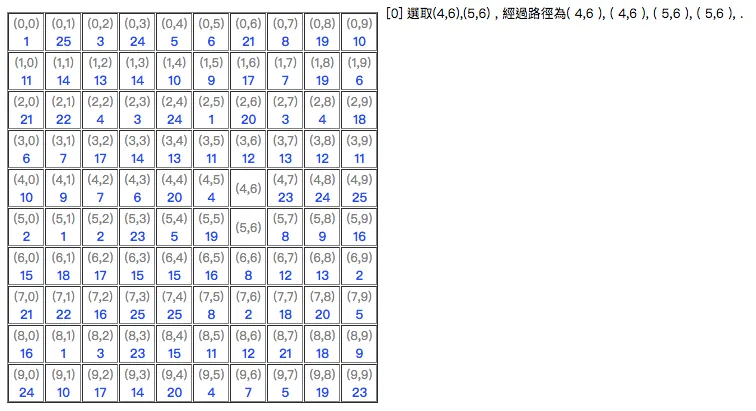
完成後的連連看已經可以真的玩:點選兩個相同圖案,若兩個轉彎內可連到就消除。
延伸閱讀
- 遊戲開發技術介紹:Graphics Library、遊戲平台與遊戲引擎怎麼選?
- 連連看圖形連線消除邏輯怎麼設計?用三條直線模型找出可消除路徑
- 遊戲棋盤怎麼畫?用 PixiJS 建立連連看盤面
- 連連看電腦搜尋路徑:讓 AI 自動找出可消除的圖案
常見問題
連連看可消除的條件是什麼?
兩個圖案相同,而且連線不超過兩個轉彎。程式上先把「圖案相同」用 `hasSameValue` 過濾掉,再用 `Path.canLinkInLine()` 判斷路徑是否存在。
為什麼連線搜尋要分六種情況?
因為可連線的路徑最多兩個轉彎,可能出現直線、一個轉彎(L 形)與兩個轉彎(Z 形/U 形)等多種形狀。分別從上下左右單向搜尋可以覆蓋直線與單轉彎;左右連消與上下連消則處理兩個轉彎的情境。
左右連消時為什麼要把搜尋範圍夾在兩點之間?
如果外側點往內搜尋超過了內側點的位置,會把繞過內側點背後的路徑誤判成可連線。程式碼裡用 `leftPointRIGHT.y`、`rightPointLEFT.y` 與兩點座標比較,把搜尋範圍夾住,避免誤判。
hasMiddleValue 回傳 true 代表什麼?
代表兩點之間「有障礙」、這條直線走不過去。函式在兩點之間掃描,只要中間有任何非 null 的圖案就回傳 true;搜尋路徑時要找的是 `!hasMiddleValue(...)` 成立的直線。
盤面是怎麼產生的?
把 25 種圖案各複製 4 份共 100 個元素,隨機排序後切成 10×10 的二維陣列。被消除的圖案會把該格設成 null,後續搜尋就能穿過這些空格。
參考資料
- 本系列前一篇文章:〈[5 – 遊戲邏輯] 圖形連線消除邏輯發想〉,IT 邦幫忙鐵人賽 2018。
- 專案原始碼:ironman20181021.zip。
最後更新
2026-08-28(原文發布於 2018-10-21,本文保留原始筆記內容並補上 GEO 結構。)
關於作者 {#author}
Claire Chang | 企業 AI 導入與流程轉型顧問。專注於 AI Agent 架構設計、ERP 系統整合與企業 AI 治理。
首次發布:2018-10-21